
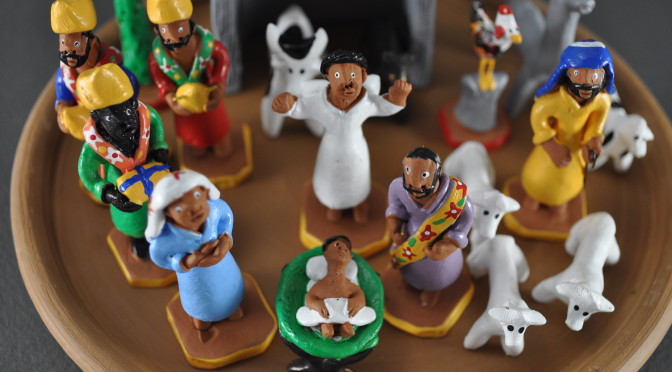
This playful Brazilian presépio or nativity is from the state of Pernambuco in the north east of Brasil, more specifically from the town of Caruaru. It was made following the tradition established by Mestre Vitalinho Pereira dos Santos, a legendary folk artist from Caruaru, famous for his intricate clay figurines depicting rural Brazilian life.
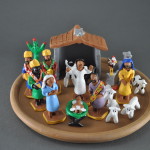
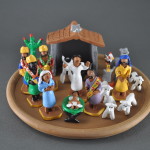
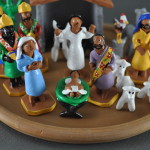
This nativity comprises of 19 painted clay pieces: Joseph, Mary, Jesus in a manger, a stable with silver star, a cactus, an angel, a shepherd, three kings, a donkey, a cow, a donkey, four sheep, a rooster and the plate on which this nativity is exhibited.
Two pieces are of note: the cactus and the rooster.
The rooster refers to the legend that a rooster was present in the stable where Jesus was born. Immediately after Jesus’ birth the rooster started to crow, thus announcing the divine birth to the world. The Midnight Mass on Christmas Eve is known in Brasil and certain other countries such as Spain and Bolivia as Missa do Galo or Misa del Gallo or the Mass of the Rooster. One cannot but make an additional connection with the rooster that crowed three times as Peter Denied Jesus.
The cactus is a great example of inculturation. As each culture started to depict the nativity they added elements borrowed from their own experience. Whereas Germans and Austrians might add evergreens, people from more arid climates added a cactus.
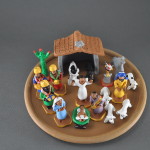
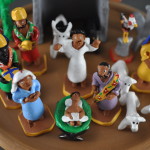
Artist: School of Mestre Vitalinho Pereira dos Santos
Country: City of Caruaru, State of Pernambuco, Brasil
Material: Clay, Paint
Height: The tallest figure is 2.5"
Width: The diameter of the plate holding the figurines is 6.5"
Number of Pieces: 19
Joseph, Mary, Jesus in a manger, a stable with silver star, a cactus, an angel, a shepherd, three kings, a donkey, a cow, a donkey, four sheep, a rooster and a plate.
Acquired: 2014
This Presepio is from the ‘interior’ of the state of Pernambuco in the Brazilian Nordeste. Specifically, from the town of Caruaru, where artisans make painted clay figures in the tradition of Vitalinho, whose name is sometimes used as a generic description of the style. We have a larger-scale (typical crèche figure size) version, with the rooster perched on a tree stump (perhaps a reference to the root of Jesse?) but no cactus.